
Key Takeways
Someone painted over the pride railing with black paint.
The air is crisp and clear this morning, the kind that lets voices travel. I hear tourists laughing somewhere behind me. People walk by with laptop bags, coffee in one hand and their phones in the other, eyes down, focused on something far away on their screens. No one looks up. No one notices the railing. In this chilly part of the city, I feel like I’m the only one sitting close to the ground because of it, stuck here by a grief I can’t move or shake. The feeling comes in waves, each one starting before the last has faded.
I don’t know when it happened. Someone said it was weeks ago, someone else said longer. There was no notice, no news story, no flyers for the community. All I have is this morning, when the fresh black paint, covering up the colors, caught me off guard and stuck in my throat.
You already know this story. Maybe it’s not this railing, or this ramp, or this block, or this street in Davie Village, but you know what it feels like, because we all have one now. The mural quietly erased. The flag taken down for maintenance and never put back. The sticker scraped off the clinic door, the crosswalk left to fade, the last bookstore turned into another vape shop with paper covering the windows and neon yellow framing the entrance. You know the silence of standing in front of the place where the color used to be. That silence doesn’t get easier. It just becomes familiar, and that kind of familiar is its own wound, one that opens again with every new scrape, every new defacement, every new attempt to erase us.
A place to hold on
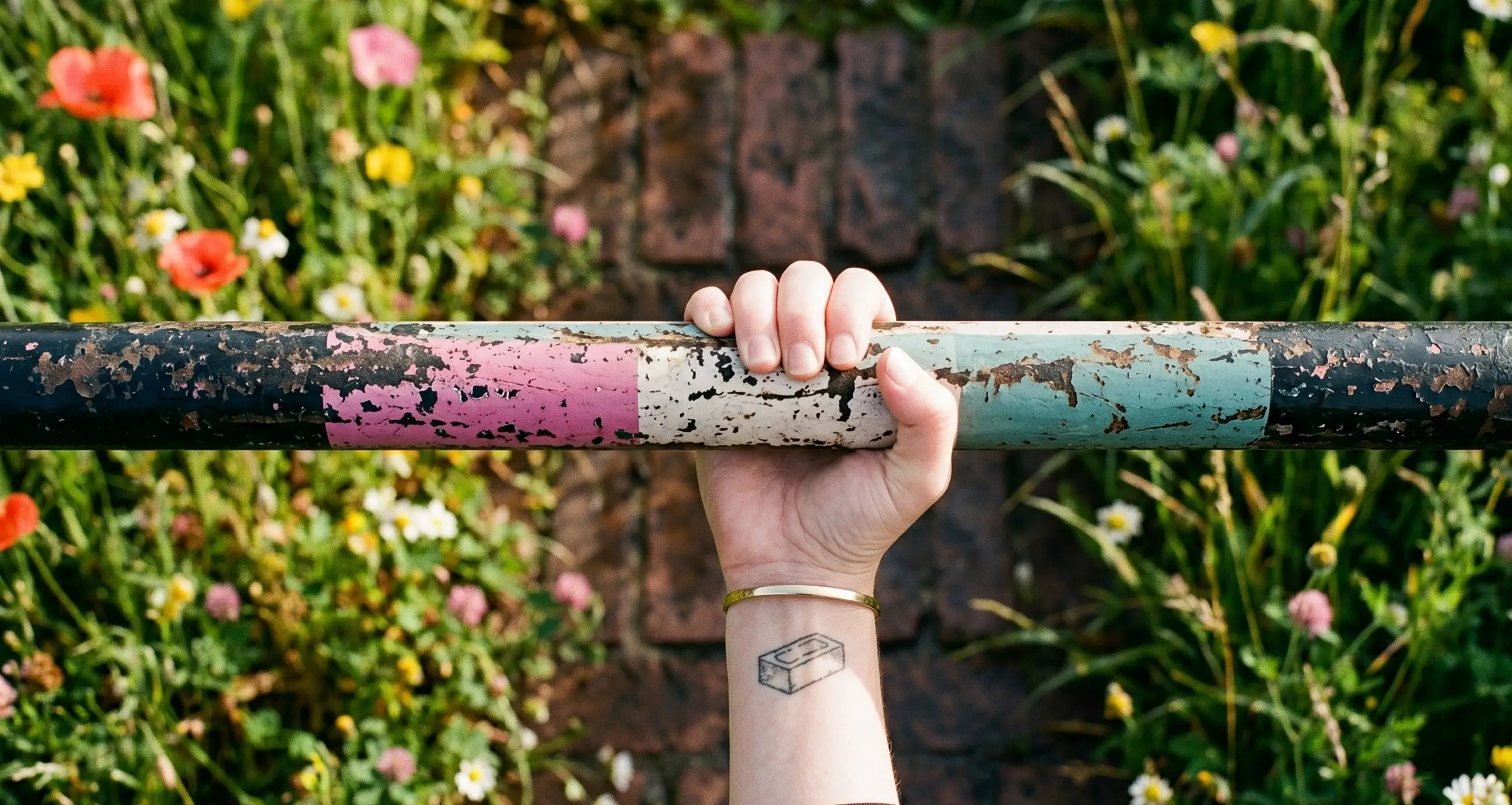
For years, this railing showed every color: the rainbow, the pink, white, and blue of the trans flag, and the brown and black stripes that asked us to stop pretending and include everyone or no one. The colors shone in the sun on good days and stayed bright through the rain, on a ramp in downtown Vancouver, in a neighborhood that only became expensive and polished long after we had already grown up here.
I am someone this world was not designed for. Doors were made for different shoulders. The light suits other eyes, and mine miss most of what’s around me, so I rely on my hands to understand the world. I reach for railings like others reach for a hand. With every step, my feet check if the ground is still there for me.
This railing did more than just help me stay steady. It gave me a place to hold on, to breathe easier, and to step away from the constant gaze of strangers long enough to find my balance. Just a few feet of painted steel on a ramp made for people often ignored, people like me, quietly saying: you might be safe here. In a world that doubts if I belong, if I even have the right to be here, that message from an object means a lot. Some days, it meant everything.
Now the steel is black. It feels like the railing was told to be quiet. It’s dark and heavy like holding your breath. The colour absorbs the light and gives nothing back, on the one structure here that was meant to help people like me find their way.
The people behind the counter
There’s a railing in front of a Starbucks. To me, the building and the steel always seemed connected. Queer people used to work behind that counter, and maybe some still do. Sometimes, our eyes and our voices would meet over the register, and for a few seconds, we weren’t just customer and barista. We were two people from the same scattered family, recognizing each other in public. Community psychologist Isaac Prilleltensky calls this mattering: feeling valued and adding value, which he says is as important to wellbeing as food or rest. Mattering can show up in laws and city plans, but it’s also there in a few seconds of eye contact at a cash register. In those moments, we mattered to each other. Those exchanges were small, but they meant everything.
I think about those workers now. In 2023, the union for Starbucks baristas said that managers in more than 20 states had removed Pride decorations or told staff not to put them up. The company denied it, but the workers went on strike anyway. Now the railing in front of this store is black, and I don’t know who painted it. Was it the coffee company, the neighbourhood business association, or the city? It stopped mattering to me when I realized something worse: whoever didn’t order it also didn’t object. Nobody spoke up. They let us be painted over, for the World Cup, for progress, for reasons no one will ever have to explain.
For years, two men stood at the end of that railing handing out pamphlets about Jehovah. Day after day, the colors and the men shared the same stretch of brick, and the rainbow stayed put. It didn’t flinch, and neither did we. The railing lasted longer than anyone who came to argue with it. But it couldn’t outlast a work order. Not hatred, just housekeeping. The slow, official removal of anything that stands out, until a city is held together by sameness and calls itself clean.
Scattered light
The FIFA World Cup 2026™ has arrived, and as I sit here, crowds keep passing by. Families and groups of friends wear jerseys for the red team, the green team, the white and navy team. All these colors move together down the same sidewalk where the rainbow once belonged, their colours rarely touching, never mixing together.
This isn't really about which team anyone supports. But I remember FIFA's history. In 2018, the men's tournament was held in Russia, five years after the country banned what it called gay propaganda. In 2022, it went to Qatar, where loving as I do is a crime. When European captains wanted to wear rainbow OneLove armbands, FIFA threatened them with yellow cards until they took them off. Security took away rainbow flags and hats at stadium gates. Belgium was told to remove the word Love from inside a jersey collar.
This year, things got even clearer. FIFA quietly dropped its own anti-discrimination campaign, called Unite for Inclusion, from the tournament now filling these streets. The U.S. White House has pushed FIFA to ban trans women from the women's game. In the UK, after a court ruling changed the legal definition of sex, the English and Scottish football associations banned trans women from grassroots women's football, from local pitches to Sunday leagues. They know we cannot safely return to the men's game, so this ban is not just a change but an exile. When a match in Seattle was scheduled during Pride, visiting federations filed formal complaints. Human rights groups have warned that removing inclusion from this tournament puts trans fans, players, and journalists at risk. Some queer supporter groups are staying home instead of risking their safety here.
I can't prove that this railing is connected to any of this. Nothing was announced. That is how it works. I only know the colours disappeared before a tournament that chose to drop the word inclusion, and I know what the timing suggests. I am tired of pretending I don't notice.
Every team colour is welcome in this city right now. People celebrate them, hang them from balconies, and paint them on their faces, as long as the colours do not come together for us. The rainbow has been scattered like light in rain, vanishing into a kind of grey, broken into pieces that are fine on their own but not allowed to come back together. The city gets them back one jersey at a time.
Where are we now? What is this place turning into? I keep asking the bricks, but the bricks stay the same.
Six blocks from the Village
Rainbow crosswalks across Metro Vancouver have been defaced many times—in Surrey, White Rock, West Vancouver, and the North Shore. Each time, the paint returns. Crews repaint, councils reject motions to remove them, and communities come together with brushes. This city created Canada’s first permanent rainbow crosswalk. When vandals target it, people pay attention, and that attention is the first step in defending it.
No one vandalized this railing. Instead, it was removed by a work order. It vanished in broad daylight, just six blocks from Davie Village. There was no outcry, no news article, no online thread, no protest, not even a single post. I checked. The silence is what stands out most in this story.
Are we too broken down and tired to notice one more paint job against us? I keep asking myself that because I think the honest answer is yes, and maybe that’s the point. Ilan Meyer spent years studying minority stress, the extra burden people carry when the world is always watching them. Some of that weight comes from outside, in laws, headlines, and even paint. Some of it comes from inside, in how we brace ourselves, stay alert, and try to make ourselves smaller. If you carry that weight long enough, exhaustion becomes a way of life. Erasure doesn’t need our permission anymore. It just needs us to be tired. Some of us have even learned to erase ourselves first, quietly, for safety, before anyone else can.
You already know all of this. You feel it deep down. The wound is out in the world, not inside us, but our bodies still keep track. Grief doesn’t care if what was lost was alive. It only asks if you loved it, and if it’s gone.
We had to fight just to keep a simple railing. In the end, we lost it to a can of paint.
What we owe each other
Disability justice writer Mia Mingus describes something she calls access intimacy. It is that hard-to-explain feeling when someone just understands what your body needs to be present, when the welcome is already there and you do not have to ask or explain. Some of you might know this from a friend who always books the table by the door without being told. For me, I felt it every day from a painted steel railing on a ramp in downtown Vancouver.
That railing was access intimacy made physical. Someone had painted both access and pride into that metal, and for years my hand understood its meaning before my mind did.
Mingus also explains that access is not just a favor given to individuals. It is a promise we make together, a way for a community to show it cares for everyone. The opposite is also true. When access and visibility are taken away at once, everyone loses something. This was not just something that happened to one tired ageing therapist on a sidewalk. It happened to all of us.
The revolution comes back to the body it lives in.
My hands are steadier now. It’s not that the grief has gone away. It’s that I’ve stopped asking it to leave.
Grief worker Francis Weller says that some of the sorrow we carry isn’t just ours. It moves through the world, and each of us holds a part of it, like the ground under this city holds the rain. What broke me open this morning is bigger than a railing and bigger than me, but it’s also just a railing, just me, just you, wherever you are reading this. Both things are true at the same time. Grief never asks us to pick one or the other.
Grief isn’t the opposite of strength. It’s the opposite of not facing, not caring, and not tending to our relationships and our losses. For weeks, people walked past that railing and didn’t notice. But a grieving woman sat down and saw everything. These tears aren’t a sign of falling apart. They show that the colours mattered, that the workers behind the counter mattered, that we still matter to each other, even when the world tries to tell us we don’t. A heart that feels this much isn’t broken in the wrong way. It shows every time we met the world with kindness anyway.
You don’t have to move from here yet. If you can’t stand, the ground will hold you. You have to sit with reality before you can feel it, and feel it before you find your footing. The footing always comes after the feeling, not before. Whether you move inward or forward, grief will let you know when it’s time. It moves at its own pace, and that pace is honest.
We’ve been pushed to the edges before. Lately, it feels like we’ve been pushed even further, back into our homes, doors closed, shades down, hiding under the covers. Under those covers, many of us are suffering alone, half-believing it’s ours to carry by ourselves. If that’s you today, I’m not asking you to come out. I just want you to know I see you. I spent this morning on the ground by a railing. Other people feel this too, and maybe that’s the truest comfort I can offer. Neither of us is too much. The world just isn’t enough right now.
When you finally get a break from the waves, find someone else who understands. Not to fix you, but just to witness you. Grief shared with others can do what hidden grief can’t: it turns back into love that has somewhere to go. That’s why gathering is so important in this work, and why, as a Vancouver-based somatic psychotherapist working online across Canada, I keep community at the center. I create spaces, even virtual ones, where you’re welcomed before you even arrive. Where no one has to prove they belong before the real conversation starts. Where your hand always finds the railing.
They can paint over a railing in one night, but they can’t erase a people. The rainbow was never really in the steel; the steel was just where we chose to keep it for a time. The colours live in us, scattered today maybe, but scattered light is still light. Rain ends, and a rainbow is what light does when it makes it through the storm.
So we begin again. We always have. Stuck somewhere in this young-minded city, someone will need something to hold on to, and until the world rebuilds it, we become that for each other.
Reach out. And I’ll reach back. That's how we do this grieving in these seemingly impossible times.
Frequently Asked Questions
Why does losing a pride symbol hurt as much as losing a person?
Grieving the loss of a pride symbol is real because these symbols give a community a sense of safety and belonging. Over time, your body learned that a railing, a flag, or a crosswalk meant you were welcome, and it started to feel like home, not just decoration. When that symbol disappears, your body feels the loss, much like losing a promise of belonging. The grief you feel reflects the love you had, not just the object itself.
Is it normal to feel too exhausted to even react to news like this anymore?
Feeling worn out by ongoing trans and queer erasure is a common effect of minority stress, not a sign of weakness. Studies show that when people face constant scrutiny and loss, their bodies eventually stop reacting as strongly, and numbness can take the place of outrage. If you hear about another removal and just feel tired, it does not mean you do not care. It means your body has carried too much for too long, and now it needs rest and kindness, not criticism.
What can I do when a pride symbol disappears in my neighbourhood, and nobody seems to notice?
Speaking up about the erasure is the first and most important thing to do when a pride symbol quietly disappears. Tell someone who will understand. Take a photo of what changed, write down what you remember, and share it with your community. Silence is what lets these removals seem like routine maintenance. You do not have to start a campaign while you are grieving. Simply noticing what happened and making sure it is not forgotten is already an act of resistance.
How do I support a trans or queer person who is grieving losses like these?
To support someone grieving erasure, begin by acknowledging their grief instead of trying to fix it. Trust that their loss is real, even if it seems small to you. Do not point out positives or suggest what to do next. Just be there with them, let the loss feel as big as it is, and remind them they are not alone. When someone feels seen in their grief without being corrected, it can help turn private pain into connection.
How can therapy help when the problem is the world, not me?
Therapy for grief caused by injustice begins with the idea that there is nothing wrong with you for feeling hurt in a world that keeps causing pain. The goal is not to make you get used to erasure. Instead, therapy gives your grief a place to go, helps steady a body that has been tense for years, and helps you reconnect with yourself and with people who can help share the burden. You should never have to defend your right to exist before real conversations can happen, whether in therapy or anywhere else.