
Key Takeways
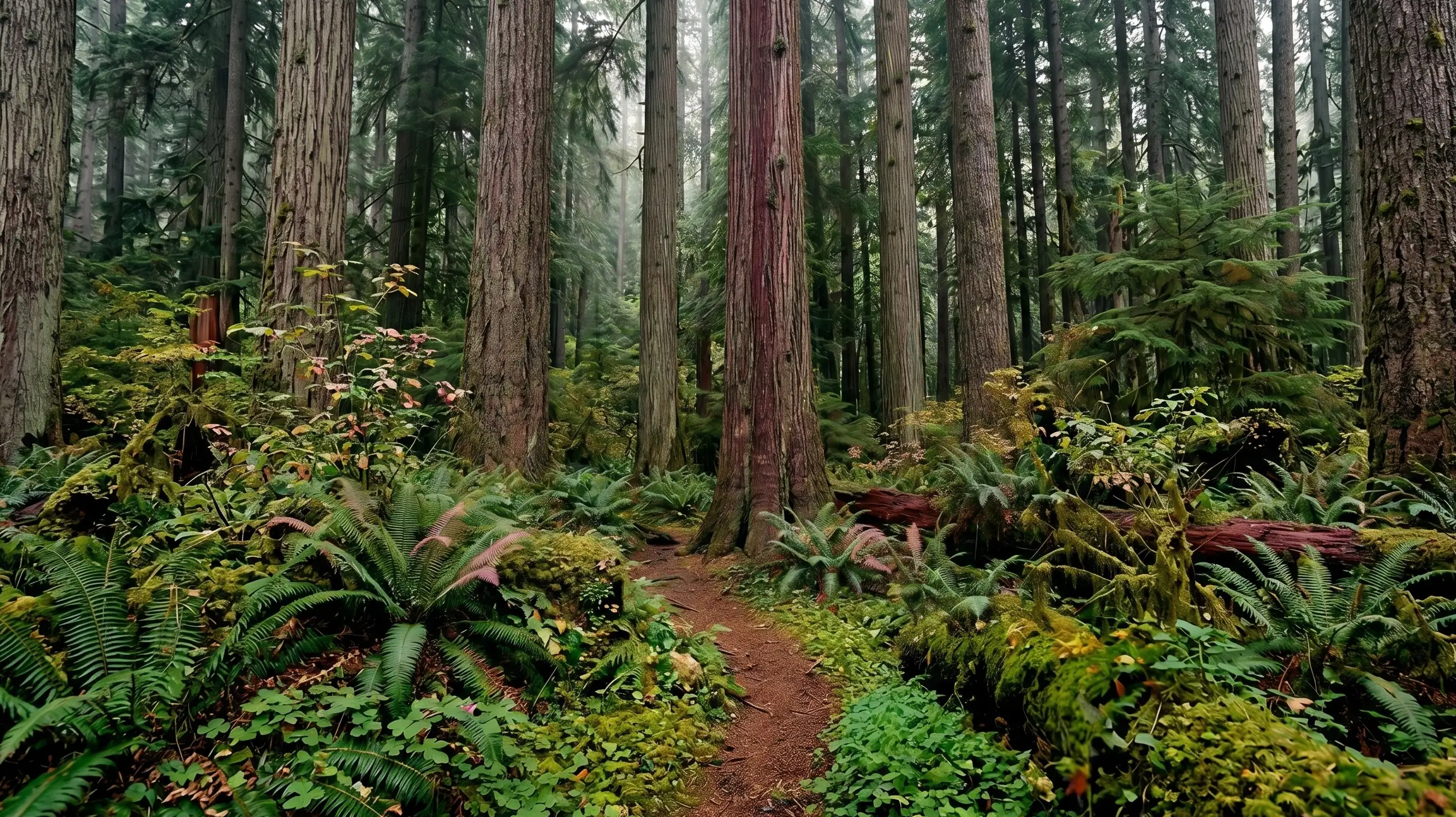
There is a particular kind of quiet that lives in the old forests around Vancouver. I find it most often in Pacific Spirit Park, in Lighthouse Park, in the deeper folds of the North Shore mountains. The Douglas firs and western red cedars do not announce themselves. They are simply present, the way something steady can be present without asking anything in return.
I walk in, and within a few minutes my breathing slows. The needles overhead diffuse the light. The moss underfoot softens every step. My hand finds the bark of a cedar, the deep furrows like a record of long time. I am still, the trees are still, and yet there is something happening between us. Humans have walked among trees for as long as we have been humans. The relationship is older than any of our names for it.
This post is about what trees offer, and what we might quietly offer back.
Steadiness held between trees, not alone
The story we sometimes tell about trees is one of solitary endurance: each tree on its own, weathering wind and storm, growing slowly and patiently in isolation. That is not what is actually happening.
What is actually happening is a forest that holds itself. Trees of different species share carbon and water through underground networks. Older trees support younger ones. Trees under stress send chemical signals to their neighbours. The steadiness we see in a forest is not the steadiness of solitary trees. It is the steadiness of trees that are not alone.
This shifts what the forest can offer us. We do not come into a forest to admire individual endurance. We come into a forest to be in the presence of mutual care, sustained through long time.
What trees do for each other underground
The science here is largely the work of Suzanne Simard, a forest ecologist at the University of British Columbia. Her decades of research, much of it conducted in BC forests, mapped what she came to call the wood-wide web: a vast underground network of fungal threads linking the roots of trees, through which carbon, water, nutrients, and chemical signals can flow. Older trees, sometimes called mother trees, function as hubs in this network. They support seedlings and other trees nearby, including, the research suggests, by recognising kin.
Peter Wohlleben's The Hidden Life of Trees, which I have returned to over the years, brought this science into wide public reading. The original Canadian research, and its ongoing continuation through the Mother Tree Project at UBC, is where the deeper credit lives. The work is also done in collaboration with First Nations, whose own knowledge of forest relationships preceded the lab science by many generations.
The image that stays with me is simple. The forest beneath my feet is not silent. It is full of relationship.
Breathing in what they offer, breathing out what they need
There is a smaller and more immediate way that trees and humans are in relationship, and it happens with each breath I take.
I breathe out, and the trees take in what I release. Trees breathe out, and I take in what they release. This is not metaphor. It is the basic biology of photosynthesis and respiration, repeated trillions of times across every forest on the planet, every minute of every day.
When I stand among trees, my breathing is part of theirs. I am not visiting from outside the relationship. I am inside it. What I exhale is something they receive. What they exhale is something I receive. The exchange has been going on for millions of years, and it is going on right now, in the cedars beside me and in the room where you are reading this.
It is hard, sometimes, to know how to settle a body that has been pushed too long. Among trees, the settling can begin without effort. The breath is already shared. The body remembers something it did not have to be taught.
A poem I keep returning to
Mary Oliver wrote a poem called When I Am Among the Trees. It first appeared in her 2006 collection Thirst (Beacon Press) and is also gathered in Devotions (Penguin Press, 2017), her comprehensive anthology.
I am not going to reproduce the poem here. Mary Oliver's work belongs in her own books, where the lines sit in their proper company and where you can read them slowly, with the pace they ask for.
What I can say is this. The poem is short. It begins with the speaker entering a stand of willows and honey locust trees. The trees in the poem are not silent. They speak, gently, in the way the world sometimes seems to speak when a person is quiet enough to hear it. They invite the reader to slow down. They suggest that being alive is a simpler thing than we often make it. The poem is famous, I think, because it does not press its meaning. It opens, and it lets the reader come closer at their own pace.
I keep this poem near me. I have read it before sessions, after sessions, and on days when nothing in particular was happening. It does not solve anything. It does what a good poem does. If you have not read it, I commend you to Devotions, or to Thirst itself, where it first appeared. The trees in the poem will tell you the rest.
What this offers in the room
Some of what I have written here lives close to my work as a therapist. People come into therapy carrying a great deal. Some of it is named. Some of it is held in the body before any of us knows what to call it. The work I do is mostly in a room, on a screen, with words. But some of what makes the work possible is borrowed quietly from the forest.
I think of mutual care, the kind I see in the relationships between trees, and I do not try to hand it to a client as a strategy. I try instead to make a room where mutual care can unfold the way it does in a forest: slowly, without announcement, in the small steady acts of attention. Two of our other reflections, on ecological psychology and on climate grief therapy, look at adjacent pieces of this same thread.
When I cannot get to a forest, I can still remember that one is breathing somewhere near me. I can remember that the body knows how to settle when it is in the company of something steady. I can bring that remembering into a session, and sometimes it is enough.
If your body is tired, you do not have to make a project of getting it to a forest. The forest is doing its work whether or not we are there to receive it. But if you can get there, even briefly, to a park near you, to a stand of trees on the way to somewhere else, let the trees do what they do. Stand. Notice. Breathe out something they will use. Breathe in something they have made.
You are not interrupting a forest by being in it. You are part of an exchange that is older than any of us. The trees have been holding each other for a long time. They can hold you for a few minutes too.
Frequently Asked Questions
Is forest bathing the same as what you describe?
Forest bathing, or shinrin-yoku, is the Japanese practice of slow, attentive time in a forest. The research on it is real, and the calming effects on the nervous system have been measured. What I describe in this post overlaps with forest bathing but is a little simpler. It is less a practice and more an honouring of what trees are already doing, and what the body is already doing in their presence.
Do I have to walk far into nature for this to count?
No. A street tree on your block. A houseplant on the desk. A small park between buildings. A view of trees from a window. The exchange is the same exchange, scaled to whatever the moment offers. The trees are not measuring our distance from them.
What about people who cannot easily get to forests?
For people with chronic pain, mobility limitations, urban living, or any number of reasons that make a forest visit difficult, the relationship is still available. Time with a single nearby tree, or even with the felt memory of a forest a person knows, can offer something. Therapy has a role here too. Imagery and embodied recall can bring the felt sense of a forest into a session.
How does this fit into your therapy practice?
I do not prescribe forest visits as homework. What I borrow from the trees is something quieter. The pace of the work, the way mutual attention is offered, the trust that something steady can hold a person without trying to fix them. These are the gifts of the forest that I try to bring into sessions.
Is this a spiritual practice or a clinical one?
It can be either, both, or neither, depending on the person. The post is offered in plain language, and I trust readers to take what fits.