
Key Takeways
In primary school, I failed cursive. I couldn't see the chalkboard, so I didn't learn the shapes of the script the way the other kids did, and the mimeographed handouts that were meant to help arrived as pale violet smudges my eyes couldn't resolve into letters. My classmates copied what was in front of them while I copied my best guess at it, and the grade that came back named my hand, my effort, my attitude as the problem. It never occurred to anyone, including me, that the problem might be the assumption underneath the lesson: that there is one legitimate way to put words on a page, and that a child who can't manage it has nothing much to say.
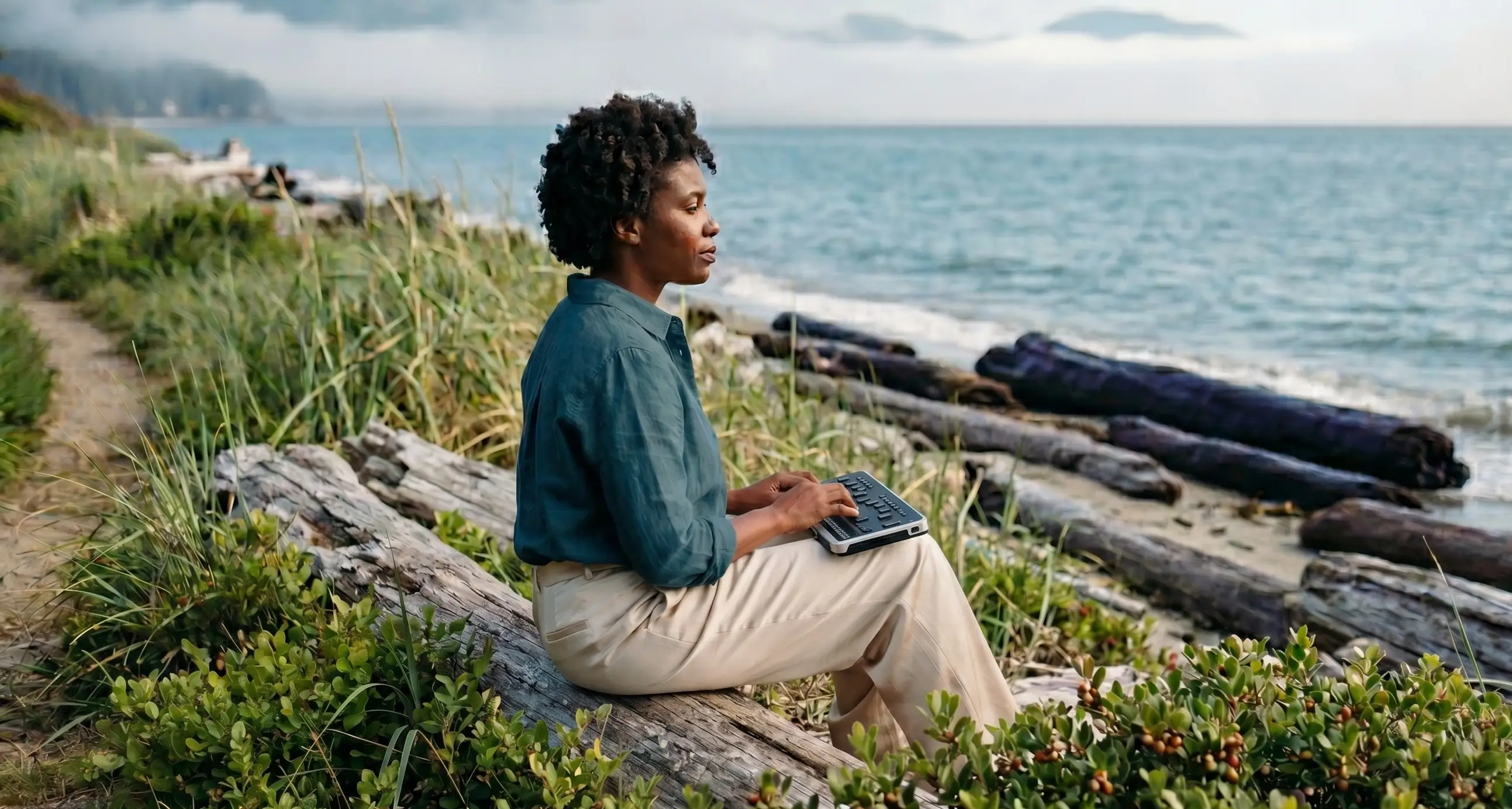
Years later I sat in front of a word processor, and writing stopped being a test of my eyes. My fingers learned the keys the way other kids' hands had learned the loops, the words came out clean and legible and mine, and I felt liberated from someone else's rules and expectations of me. That machine became a computer, the computer became the tablet I write on now with its keyboard-inclusive cover, and what began as an accommodation became the way my thoughts and feelings have been accompanied through my life. I am blind. I have some vision, and none of it has ever been enough to read a chalkboard or a page on its own, so the keyboard was never a convenience for me. It was the difference between writing and not writing.
I'm a psychotherapist now, and I work online across Canada from here in Vancouver, where a good part of my practice sits with people whose access to ordinary life keeps getting debated by people who never ask them. This post is about that debate, because it has a shape, and the shape repeats. A new technology arrives. Disabled people adopt it early, since for us it isn't novelty, it's entry. The public hesitates, moralizes, and asks whether the tool is legitimate, whether it's cheating, whether it's worth the cost. You've heard this argument about AI in the last three years. I've been hearing it my whole life.
One technology, two welcomes
The keyboard that met me was older than I knew. The first typewriter was built in 1808 by Pellegrino Turri so that a blind friend could write legibly, which means the machine that ended my fight with cursive was invented, at its origin, for someone whose eyes worked like mine. From there the lineage runs in a nearly straight line, and the history of accessible technology, which the Michigan State University Libraries charts in a public timeline, reads like the same story told on repeat. The typewriter became ordinary office furniture, and no one calls typing a crutch. Talking books arrived in 1934 for blind readers, and under the licensing agreements of that era it was illegal for sighted people to listen to them until 1948, so for fourteen years the wall between the two receptions was written into contracts. Vint Cerf, who is hard of hearing, developed the host protocols of ARPANET in 1972 and used text over the network to reach his deaf wife, a habit the rest of the world would adopt as email and then prefer as texting. Ray Kurzweil built his reading machine in the mid-1970s so blind people could read print, inventing optical character recognition along the way, and the descendants of that machine now live inside every scanning app and searchable PDF. The first screen reader followed at IBM in 1986. Each of these began as a tool for disabled people, carried a period of pity or suspicion while we were its main users, and then crossed into everyone's hands, where it stopped being an apparatus and became, simply, how things are done.
Angela Glover Blackwell calls the crossing the curb-cut effect, after the sidewalk cuts that disability activists fought for in the 1970s, which now carry strollers, luggage, and delivery carts so smoothly that few people wonder where they came from. Her essay is usually read as good news, and it is. Read from the disabled side, though, it also reveals the part of the story that doesn't change: the warm welcome arrives only once nondisabled people become the users. While the tool is still mainly ours, the reception is different. A study in Disability and Rehabilitation: Assistive Technology found that young adults who use assistive technology routinely meet attitudes that hinder their participation in daily life, and the themes the researchers drew from their accounts were being seen and treated as different, having assumptions made about them, and other people's impatience. Stares for the device, doubt for the person, a quiet tax on every public errand. The same technology earns two welcomes, and which one you receive depends on whether you needed it.
Those welcomes were never only social, either, because even the legal right to show up had to be forced. Disabled activists occupied a San Francisco federal building for nearly a month in 1977 before the regulations enforcing Section 504, the first broad American protection against disability discrimination, were finally signed, and the Americans with Disabilities Act followed in 1990 after years of the same fight. Canada's federal turn came generations later, with the Accessible Canada Act in 2019 and the Accessible British Columbia Act in 2021. Each of those laws was contested in the same vocabulary that meets each new access technology: too expensive, too inconvenient, too much for too few. The vocabulary is the constant. Only the tool changes.
What going online gave me
My own schooling ran on the older technology of that lineage. Through my childhood, a closed-circuit television sat between me and the printed page: a camera mounted over a tray, a page placed beneath it, the text enlarged on a screen until my eyes could hold it. The machine was the size of small furniture, it hummed, and everyone in the room could see who needed it, which was the bargain assistive technology kept offering me: access, paid for in visibility. Digital magnifiers eventually shrank that bargain into something I could carry, but the classroom itself never changed. Whatever lived on the board reached me through other people's notes, which meant other people's choices about what mattered, and the gap between what was taught and what I could reach settled into my transcripts. My grade point average through those years sat at 2.0, and my body kept a record of what the negotiating cost long before I had language for what was being recorded.
Online learning changed the mathematics of my education in a single semester. The source material came to me directly, in formats my eyes and my screen reader could work with, at a pace my nervous system could hold, and nobody stood between me and the page deciding what I got to know. I wrote my own notes, on my own keys. My average across those final years was 4.25, and I offer the number as evidence rather than as a boast, because nothing about my mind changed between the 2.0 and the 4.25. The room changed.
The institutions are still catching up to what that semester taught me. The bodies that accredit doctoral training in psychology in the United States and Canada continue to hold that a doctorate must be earned mostly in person, and a fully online path to the PhD remains closed, which quietly closes it to many of the disabled students it would serve best. The research has moved past the suspicion. A 2025 review in the Journal of Computing in Higher Education synthesized ninety-one studies and concludes that online learning can meet disabled students' needs in ways campus instruction often cannot, and a research brief from the ADA National Network finds that disabled students describe feeling a sense of control over their own learning in online courses. The pattern from the timeline holds here too. When remote study was mostly ours, it was lesser, suspect, not real school; when a pandemic made everyone its user, it became simply how things are done, and the suspicion has survived mainly where it keeps disabled people out.
In my last two years of university I helped other disabled students find their way into online study and adaptive technology, and what struck me was how little of it anyone had been taught. Each of us had been improvising a private workaround for a public failure, alone. Haben Girma, the first Deafblind graduate of Harvard Law School, writes in her memoir about arriving in 2010 to find her course materials available as accessible digital files, and she credits that access to the decades of disability advocates who cleared the path before her. That is the honest shape of the lineage. Few of those tools appeared because an institution decided students like me were worth the cost. They appeared because disabled people kept building, demanding, and teaching one another while the argument about whether we should have them carried on overhead.
When a tool meets a life
Some of that building grew into whole technologies. If you want to know what access looks like when disabled people shape it, ask a blind person about JAWS. The name stands for Job Access With Speech, and it's a screen reader, software that turns what's on a screen into synthesized speech or braille. Ted Henter, the programmer who created it in the late 1980s, was blind himself, and the tool has been refined for almost four decades by a community of blind engineers, testers, and everyday people pushing it against real work. A 2025 study of employed blind adults in the United States reports that JAWS remains the screen reader most used at work and that most blind professionals run more than one, switching between tools depending on the task. Notice the direction of the adaptation: the tools bend toward the work, and the worker doesn't have to flatten their work to fit the tool.
The technologies that last in disabled life tend to share that architecture. The white cane has served blind people for more than a century, partly because it does something no hidden gadget can: it speaks to everyone nearby, telling drivers and cyclists and fellow pedestrians that the person holding it moves through the world differently, before anyone has to guess. Closed captions came out of deaf advocacy and now run in noisy gyms and quiet waiting rooms. Be My Eyes, the app that connects blind people to sighted assistance through a phone camera, was founded by a man who is himself visually impaired. None of these promises to transform anyone, and that is the point. Each one meets a life where the life already is, and then keeps showing up.
I belong to a Facebook group where blind and low-vision people trade what works, and it's a quietly stirring room. Somebody shares a trick for reading a medication label, and somebody else answers at midnight with a better one. People describe reading their own thermostat without asking, matching their own clothes without a second opinion, or reading a picture book to their child with no one else in the room. These sound small until you've lived without them, and then they're not small at all. They're the architecture of an ordinary day, returned piece by piece.
There's a phrase I've started using for this kind of access, because the existing language keeps reaching for transformation and missing the point. I call it life-meeting. A life-meeting tool is one whose offer was shaped by the people who use it, and whose promise isn't to change your life but to meet it, at your pace, in your format, on your terms. The white cane is life-meeting. The screen reader is life-meeting. So was the talking book, which is why it stings that the question of whether listening counts as real reading has outlived the licensing laws by seventy years. And a life-meeting tool leaves room for what the person brings to the meeting. The keyboard was the technology; memorizing its keys was my part of the bargain, the adaptive strategy I laid over the tool until the two of us worked as one thing. Access has always been that kind of partnership. The tool meets you partway and trusts you with the rest, which is precisely what a hypothetical user, dreamed up in a design lab, can never be trusted to supply.
AI, and the welcome it gets
Now the new technology is AI, and three years into this era the public vocabulary around it is shortcut, cheating, slop, and waste. Much of that criticism lands on real failures, and I'll get to them. But it's worth saying plainly that AI breaks the pattern of the typewriter and the talking book in one honest way: it was not invented for disabled people. No one built these models so a blind person could read her mail. The access is in there anyway, sitting inside the technology's components, and it's being found, tested, and passed along by blind users themselves, mostly ahead of the companies, who have given little considered thought to how we'd use what they built. The technology can create equity. What's missing is anyone in the boardrooms recognizing that, because disabled voices aren't centred in the conversation about AI, and most of the time they aren't included at all.
You can see the finding-out happening in real time. The Lighthouse for the Blind in Seattle, where the instructors teaching this material are blind themselves, describes the tools their community has put to work: Be My AI, which describes a submitted photo in detail; Seeing AI, which reads multi-page documents aloud; VizLens, which lets someone photograph the flat control panel of a microwave and hear each button named under a moving fingertip; OKO, which reads walk signals through a phone camera and replicates the crosswalk chirp; a JAWS feature that checks your framing on camera before a video meeting begins. In my Facebook group, the same improvisation runs all day: reading mail, identifying what's in the fridge, getting an unfamiliar bus stop described, pulling text out of images no screen reader can parse. A study presented at the leading conference on computing and accessibility documents this folding-in, blind people adopting generative AI as a layer alongside the cane and the screen reader rather than a replacement for them, with their expertise already stretching what the systems can do. For us this isn't novelty. It's the newest branch of a lineage that runs back through the reading machine and the talking book to a typewriter built in 1808, and we've embraced each branch for the same reason: the quest for equitable access doesn't wait for public opinion.
Whether the systems will be stretched in our direction is a different question, and the early evidence gives me pause. A 2026 paper in Frontiers in Digital Health argues that assistive technology for blind and low-vision people keeps cycling from launch to abandonment because it's designed without sustained participation from the people it claims to serve, which is the scholarly way of saying we still aren't at the table. The disability community has a name for what gets built in our absence: Liz Jackson names it the disability dongle, in an essay written with Alex Haagaard and Rua Williams, the award-winning prototype designed for a hypothetical disabled person that solves a problem actual disabled people never had. Jackson and Williams have also traced how technologies developed in disability's name keep finding their way into military contracts, a pipeline that deserves its own post rather than a paragraph here. I raise both briefly because they show what happens on the production side when disabled people are treated as inspiration rather than as authors, and they're why the disability justice movement, whose principles I've written about living with, puts leadership of the most impacted first.
Production, though, isn't where this post lives, because the deeper pattern sits in the reception. The same model that gets called slop when a student leans on it is called independence when a blind person reads her own mail with it, and the public conversation has barely noticed that it's describing one technology. I'm not asking anyone to resolve that tension in AI's favour. I'm asking you to notice who has been here before. Whenever a new tool has carried the possibility of equitable access, disabled people have moved toward it while the general population hesitated, and the argument about whether we should have it has been conducted, again and again, without us. The welcome a technology gets has never depended on what the technology does. It has depended on who is seen using it.
What AI honestly costs
None of this asks you to trust AI, and I don't extend it unconditional trust myself. A chatbot is not a therapist, and the same systems that describe a scene for a blind person will also flatter a lonely one at three in the morning; I've looked closely at that research in an earlier post, including the documented cases where it has gone badly wrong. The regulation that would make any of this safer is still being written, in Canada as much as anywhere.
The environmental ledger is real too. The Environmental Law Institute reveals that data centres now draw about 4.4 percent of American electricity, up from 1.9 percent in 2018, and that training a single large model evaporated roughly seven hundred thousand litres of clean water in cooling. Those costs fall on watersheds and local grids rather than on the person opening the app, and pretending otherwise would be its own kind of inaccessibility, a refusal to see what someone else is carrying.
So both things are true, and I'm asking you to hold them together rather than choose between them. Every technology we use sits inside a larger reckoning about what we over-build and over-consume, and AI belongs in that reckoning alongside fast fashion, factory farming, and the rest. Disabled people aren't asking to be exempted from the reckoning. We're asking to be in it, because we've been the early users of contested access technology for two centuries, and because a full accounting would weigh the water alongside a cost that almost never makes the ledger: what inaccessibility extracts, daily, from the bodies of the people locked out.
What inaccessibility costs the body
That extraction is where my work as a therapist begins, because the arguments in this post don't stay outside the people they're about. A 2025 study in Rehabilitation Psychology shows that ableist discrimination predicts depression in disabled adults directly, and that internalized ableism, the version a person absorbs from the surrounding culture, deepens that load by slowly wearing down their ability to settle their own emotions. Researchers call this minority stress, and psychology is only beginning to apply the frame to disability, partly because, as a recent review of the field's own history examines, the discipline spent much of a century treating disabled people as problems to be measured rather than a community to be answerable to. More than one in four adults lives with a disability. The largest minority is the one the conversation keeps happening without.
In the body, none of this announces itself as politics. The somatic scholar Rae Johnson describes embodied microaggressions as a thousand paper cuts, and that's closer to how it arrives in my practice and in my own nervous system: the stares the photovoice participants photographed, the assumptions, the impatience, each one small enough to dismiss and none of them ever quite finished landing. Maybe it runs in the activated direction for you, shoulders that climb before you ask one more time for the document in another format, a breath that stays shallow wherever access might be refused. Or maybe it runs the quieter way, a flatness that settles in after years of negotiating for entry, the long sigh of deciding the request isn't worth making, days that blur. Neither direction is a malfunction. Each is a template a nervous system learned in rooms that demanded proof before granting entry, and a learned template can, slowly and with company, be relearned.
Therapy can't rewrite licensing law or redesign an interface, and I won't pretend otherwise. What it can hold is the body's accumulated record of the fight: the bracing, the flatness, the internalized voice still grading your cursive. In relational therapy online, the relationship itself is where that record gets met, at your pace, with nothing to prove at the door, and the conversation about your life happens with you in it, which for many disabled people is itself unfamiliar ground. Access also shapes how I practise, not only what I write about; accessible therapy is a commitment I keep returning to rather than a feature I added. You don't need to perform anything here, least of all worthiness of entry.
The ordinary, returned
I'm writing this on a keybaord, and my fingers are doing what they've done since the word processor gave me a way past cursive: finding the keys without looking, because the looking was never going to be mine. Nothing about this is remarkable, which is the whole gift. The machine that let me write was once an accommodation with a file number, and now it's just how I think, the way the talking book was once contraband for sighted listeners and is now how so many people read on a commute. Life-meeting technologies tend to end up here, in the ordinary, and the question has always been how long disabled people are made to argue for them first.
So when the next argument starts, and it has already started, listen for who's missing from it. The conversations about typewriters, talking books, online classrooms, and AI have never really been about ink, tape, bandwidth, or water. They're about whether the people most affected get to author the terms of their own access, and disabled people have been answering that question for two hundred years, one early adoption at a time. We have always been the early users. We have rarely been the invited authors. The distance between those two things is where ableism lives, and it closes the way it has always closed: when the conversation finally happens with us in the room, and the tool, at last, is allowed to simply meet the life.
Frequently Asked Questions
What is the curb-cut effect?
The curb-cut effect is the well-documented pattern in which accessibility features designed for disabled people end up benefiting everyone. The name comes from the sidewalk curb cuts that disability activists fought for in the 1970s, which now serve people pushing strollers, wheeling luggage, riding bikes, and making deliveries. Typewriters, audiobooks, and text messaging followed the same arc. The effect is worth knowing, and it's also worth holding carefully: access for disabled people doesn't need to benefit everyone else to be justified.
Is listening to audiobooks really reading?
Listening to an audiobook engages the same comprehension, memory, and meaning-making that print reading does, and for many blind, low-vision, dyslexic, and otherwise disabled readers it is reading, full stop. Talking books were created in the 1930s so blind people could read independently, and for their first fourteen years it was illegal for sighted people to listen to them at all. The lingering idea that audiobooks are cheating says more about who the format was built for than about what the listener's mind is doing.
What is a disability dongle?
A disability dongle is a term coined in 2019 by disabled design advocate Liz Jackson for an "innovative" product designed for disabled people without meaningful input from them. These devices tend to win awards and media attention, solve problems disabled people never had, and then quietly disappear, while the tools disabled people actually rely on, like the white cane or sign language, get framed as outdated. The term gives us language for the difference between access that meets a life and a product that performs concern for one.
How can AI tools support blind and low-vision people?
AI image description lets blind and low-vision people read mail and medication labels, identify objects and clothing, get scenes and unfamiliar intersections described in real time, hear the buttons of a flat control panel named under a fingertip, and pull text from images that screen readers can't parse. Research on blind people's use of generative AI finds these tools working as a layer alongside trusted technologies like the white cane and the screen reader, not as a replacement for them. The benefit depends heavily on whether blind people help shape the tools, which is why participatory design matters as much as the technology itself.
How does ableism affect mental health?
Ableism affects mental health through both discrimination and internalized ableism, and research applying the minority stress model to disability links each of them to depression in disabled adults. The daily load of negotiating access, justifying needs, and absorbing a culture's messages about disabled bodies accumulates in the nervous system, sometimes as chronic bracing and sometimes as flatness and withdrawal. These responses are learned, understandable adaptations to inaccessible environments, and with support they can soften.